
Indian Grandmaster Koneru Humpy has withdrawn from the FIDE Women's Candidates Tournament, citing concerns over her personal safety amidst the West Asia conflict.

Two youths from Rajasthan were killed in drone attacks in Oman amid the ongoing conflict involving the United States, Israel and Iran.
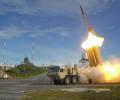
The US has reportedly depleted nearly half of its advanced missile-defence interceptors while defending Israel during recent hostilities with Iran, raising concerns about future readiness.

Crude oil prices are projected to fall significantly this year, driven by hopes of a peace deal between the US and Iran, which could lead to the reopening of the Strait of Hormuz, and a notable drop in Chinese demand for seaborne crude imports.

'The situation globally is quite challenging, but we have the confidence and courage of conviction that we will come out winners even in this challenging time.'

Iran's national soccer team attended visa appointments in Ankara, Turkey, applying for Canadian visas and some players also submitting applications for US entry ahead of the 2026 FIFA World Cup, which will be co-hosted by the United States, Canada and Mexico.
The Indian rupee saw a significant appreciation against the US dollar following President Trump's suspension of military strikes against Iran and the Reserve Bank of India's decision to maintain its key interest rate. Market sentiment was further buoyed by positive comments from the RBI regarding the health of the banking sector.

In April alone, they snapped up shares worth Rs 19,664 crore, recording their biggest buy since October 2024.

Chinese President Xi Jinping has called for the Strait of Hormuz to remain open for normal passage of ships, describing it as an 'international waterway' amid rising tensions between the US and Iran.
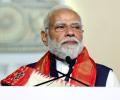
Congress leader Rahul Gandhi has criticised Prime Minister Narendra Modi's call for citizens to make economic sacrifices in response to the West Asia conflict, calling it 'evidence of failure'. Gandhi accused Modi of shifting responsibility onto the public and being incapable of running the country.

The Pakistan Cricket Board (PCB) has announced that the initial stages of the Pakistan Super League (PSL) will be held without spectators due to regional tensions and government austerity measures.

The US military carried out 'self-defence strikes' targeting Iranian missile launch sites and boats near the Strait of Hormuz, even as President Trump announced progress in ceasefire negotiations, stating Iran's enriched uranium will be 'turned over' or destroyed.

US-Iran talks in Islamabad collapsed after 21 hours, exposing deep divisions over nuclear ambitions and sanctions.

An Indian national was killed in an attack on Kuwait International Airport, prompting the Indian Embassy to offer condolences and assistance. The attack, attributed to Iranian strikes, led to the suspension of air traffic and caused casualties and damage.

The United States military has intercepted and destroyed two Iranian attack drones that posed an immediate hazard to commercial shipping lanes in the Strait of Hormuz, according to an official statement by the US Central Command late Saturday.

Indian benchmark indices Sensex and Nifty experienced a significant slump in early trade, mirroring weak global trends, as escalating tensions in West Asia, particularly a drone attack on the UAE's Barakah nuclear facility, pushed crude oil prices higher. Track Sensex, Nifty50 movement and key market drivers for May 18, 2026.

Srivastava warned that continued bombing of Iran by the US and Israel could severely undermine any prospects of reopening critical maritime routes through negotiation with Tehran.

US Secretary of State Marco Rubio met with Pakistan's Foreign Minister Ishaq Dar amid American demand that countries mediating the peace talks with Iran join the Abraham Accords and establish diplomatic and economic ties with Israel.

US President Donald Trump warned Iran of potential escalation despite a recent ceasefire agreement, stating that US forces will remain in the region until a 'real agreement' is reached.

Indian equity benchmark indices, Sensex and Nifty, tumbled nearly 2 per cent for the fourth consecutive session, driven by elevated crude oil prices, escalating US-Iran tensions, unabated foreign fund outflows, and a depreciating rupee.
Indian equity benchmark indices, Sensex and Nifty, tumbled nearly 2 per cent for the fourth consecutive session, driven by elevated crude oil prices, escalating US-Iran tensions, unabated foreign fund outflows, and a depreciating rupee.

A new assessment by the Institute for the Study of War (ISW) reveals that a power struggle within Iran's leadership, with hardliners gaining influence, could significantly impact future negotiations with the United States.

Indian benchmark indices Sensex and Nifty closed marginally lower due to profit-taking, following the Reserve Bank of India's decision to keep the repo rate unchanged while lowering its growth expectations for the current fiscal year and forecasting higher inflation.

Analysts say long-term investors may still benefit, but recommend limiting bullion exposure to around 10 per cent.

A Pakistani delegation, led by Army Chief Field Marshal Asim Munir, has arrived in Tehran to mediate the ongoing conflict between the US and Iran, following initial talks in Islamabad.

Trump claimed on social media that recent US-Iran discussions were 'very good and productive' and aimed at a 'complete and total resolution' of the conflict.

Tensions escalate as Iranian forces attack a container ship in the Strait of Hormuz after Trump announced the ceasefire extension.

Indian equity benchmark indices Sensex and Nifty rallied in early trade, driven by reports of a second round of talks between the US and Iran, which are fostering hopes for a resolution to the West Asia conflict, coupled with Brent crude oil prices trading below the USD 100 per barrel mark.

An Iranian delegation, led by Foreign Minister Abbas Araghchi, is expected to arrive in Islamabad for the second round of peace talks with the US, according to Pakistani media reports. This follows a phone call between Deputy Prime Minister Ishaq Dar and Araghchi regarding the US-Iran ceasefire and Pakistan's diplomatic efforts.

US Secretary of State Marco Rubio stated that significant progress has been made in negotiations with Iran to reopen the Strait of Hormuz, a critical global shipping lane. However, President Donald Trump remains cautious, vowing not to accept a 'bad deal' regarding Iran's nuclear programme and regional stability.

'As re-industrialisation gathers pace across regions like Asia, Europe and the US, a wide range of products and inputs will see demand.'

J D Vance heads to Islamabad for high-stakes US-Iran talks, balancing cautious optimism with a warning against bad faith. negotiations.
China has called on Iran to reopen the Strait of Hormuz and expressed appreciation for Tehran's commitment not to develop nuclear weapons, a key demand of the US to end the conflict.

Iranian Foreign Minister Abbas Araghchi said his trip to Islamabad was "very productive" and involved "good consultations" with Pakistan's top leadership amid uncertainty over the second round of peace talks to resolve the war in West Asia.

Indian benchmark equity indices, Sensex and Nifty, experienced a decline in early trade, ending a three-day rally, primarily due to heavy selling in IT stocks and concerns over prolonged instability in West Asia.
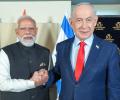
The Congress party has criticised the Indian government's diplomatic strategy, claiming a 'severe setback' if reports of Pakistan mediating between the US-Israel and Iran are accurate. The party alleges Pakistan's diplomatic engagement has surpassed India's, despite military successes.

Iran has submitted its latest proposal aimed at advancing negotiations to end the ongoing West Asia conflict with the US, days after the Islamic Republic submitted a fresh proposal through regional intermediaries to cease its military operations in the Strait of Hormuz, which is likely to get rejected by Washington.

Speaking to reporters aboard Air Force One, Trump said the US prefers a negotiated settlement and expects cooperation from Iran on securing nuclear-related materials.
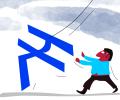
The Indian rupee depreciated by 52 paise to settle at 93.35 against the US dollar, driven by failed US-Iran peace talks, surging crude oil prices due to a potential US blockade of Iranian ports, and a global flight to the greenback. This geopolitical uncertainty is also leading to foreign capital withdrawal from domestic equities.

US President Donald Trump has indefinitely extended the ceasefire with Iran at the request of Pakistan, aiming to allow Tehran's leadership time to form a unified proposal to end the seven-week war.
